EN

FLN48-12 SF6 Indoor Load Break Switch
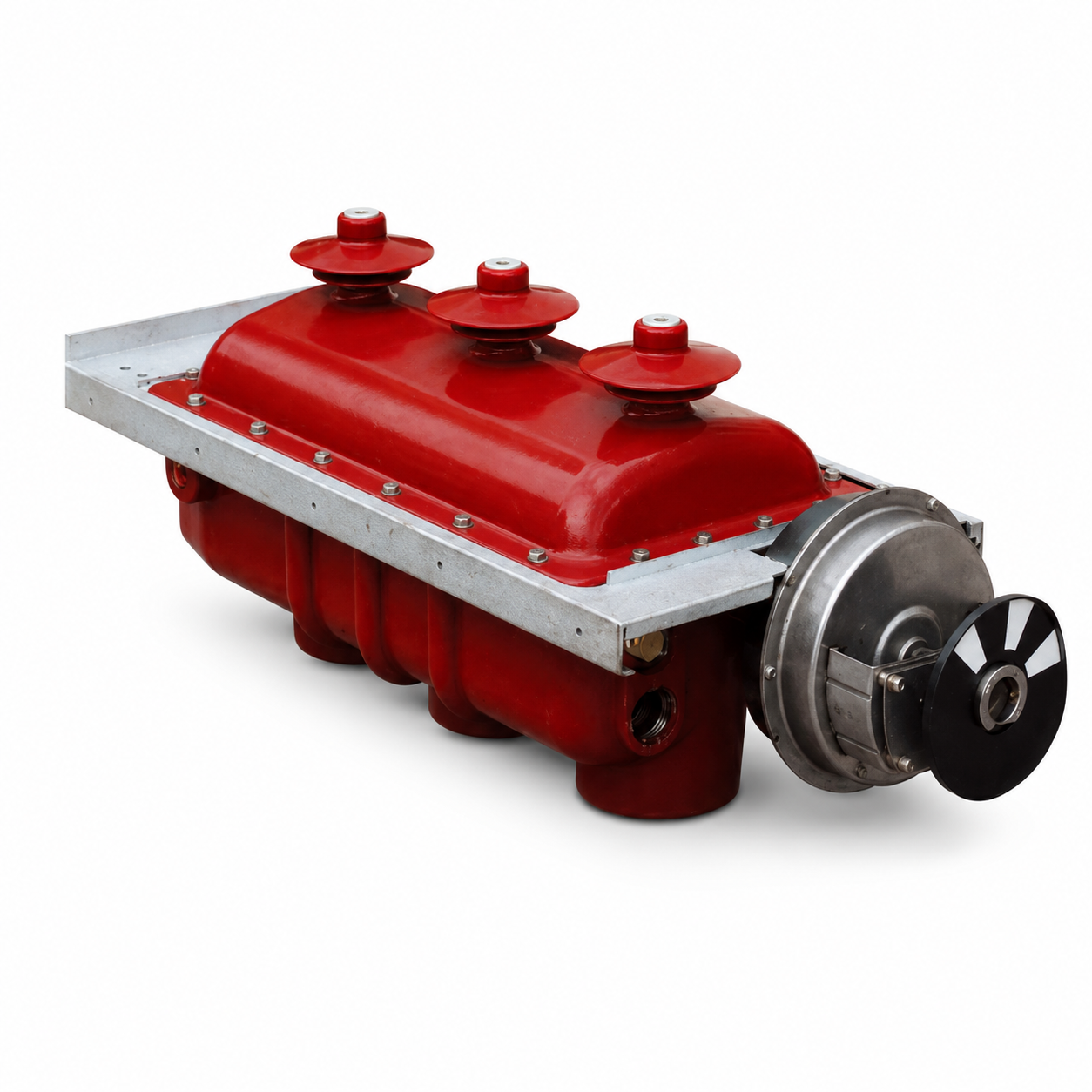
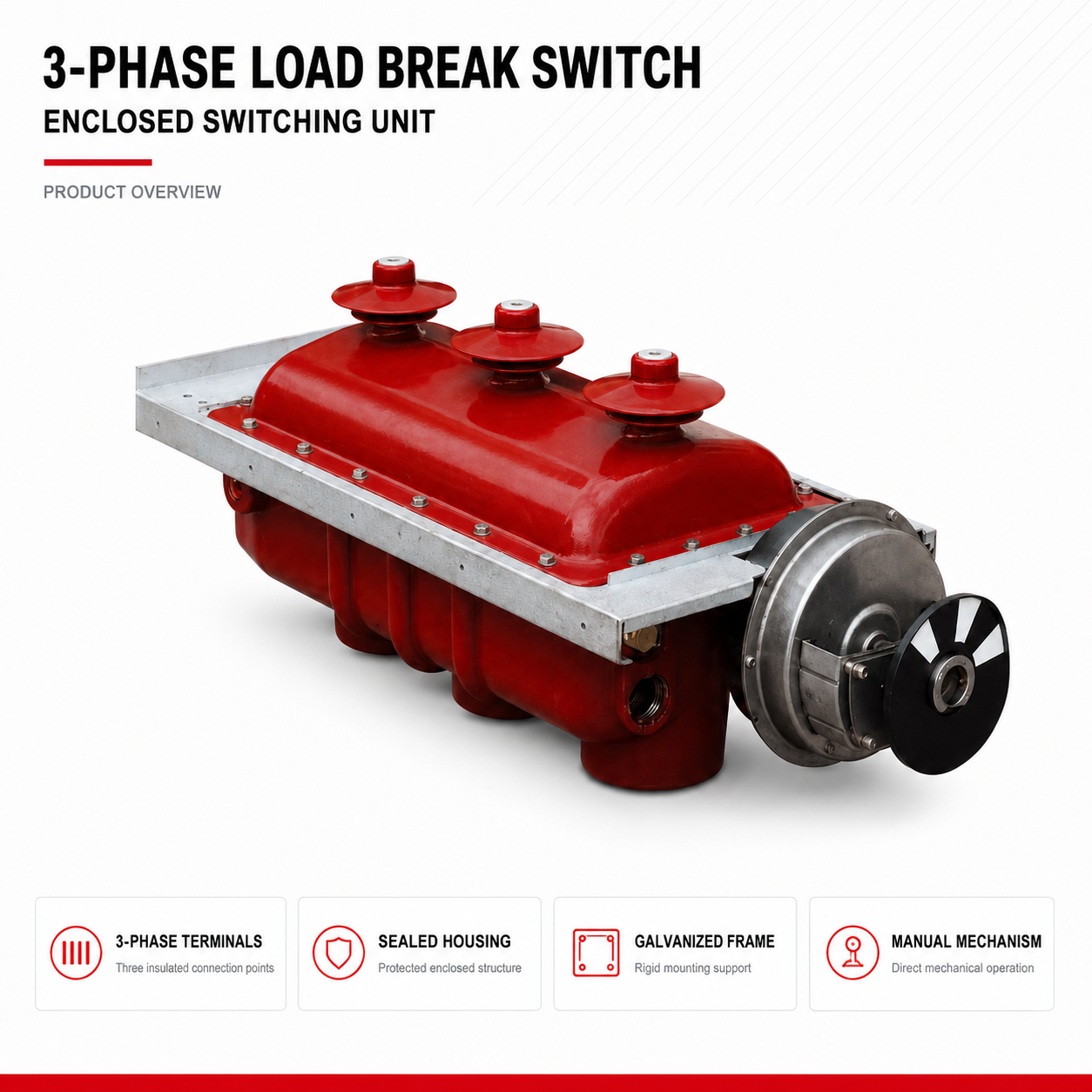
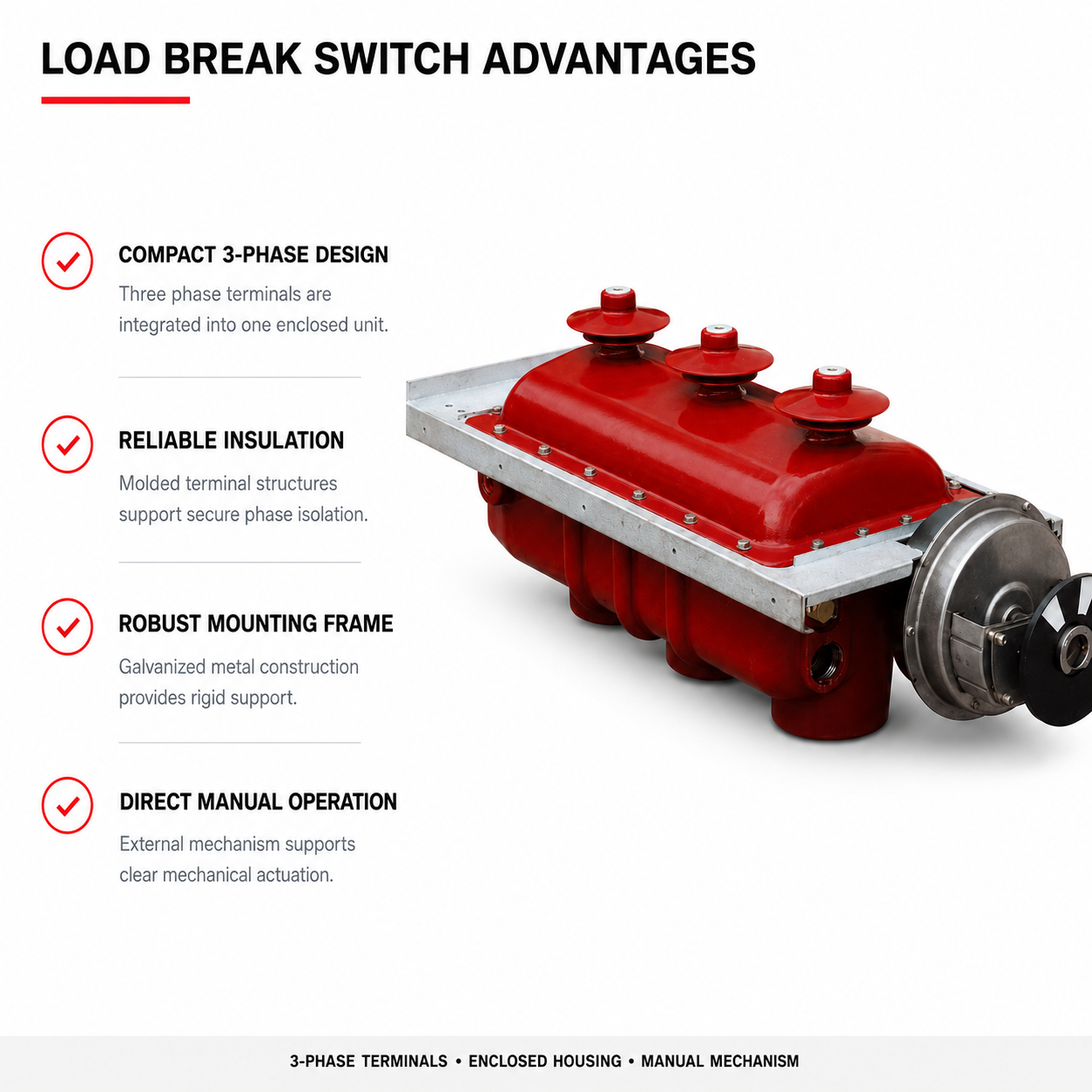
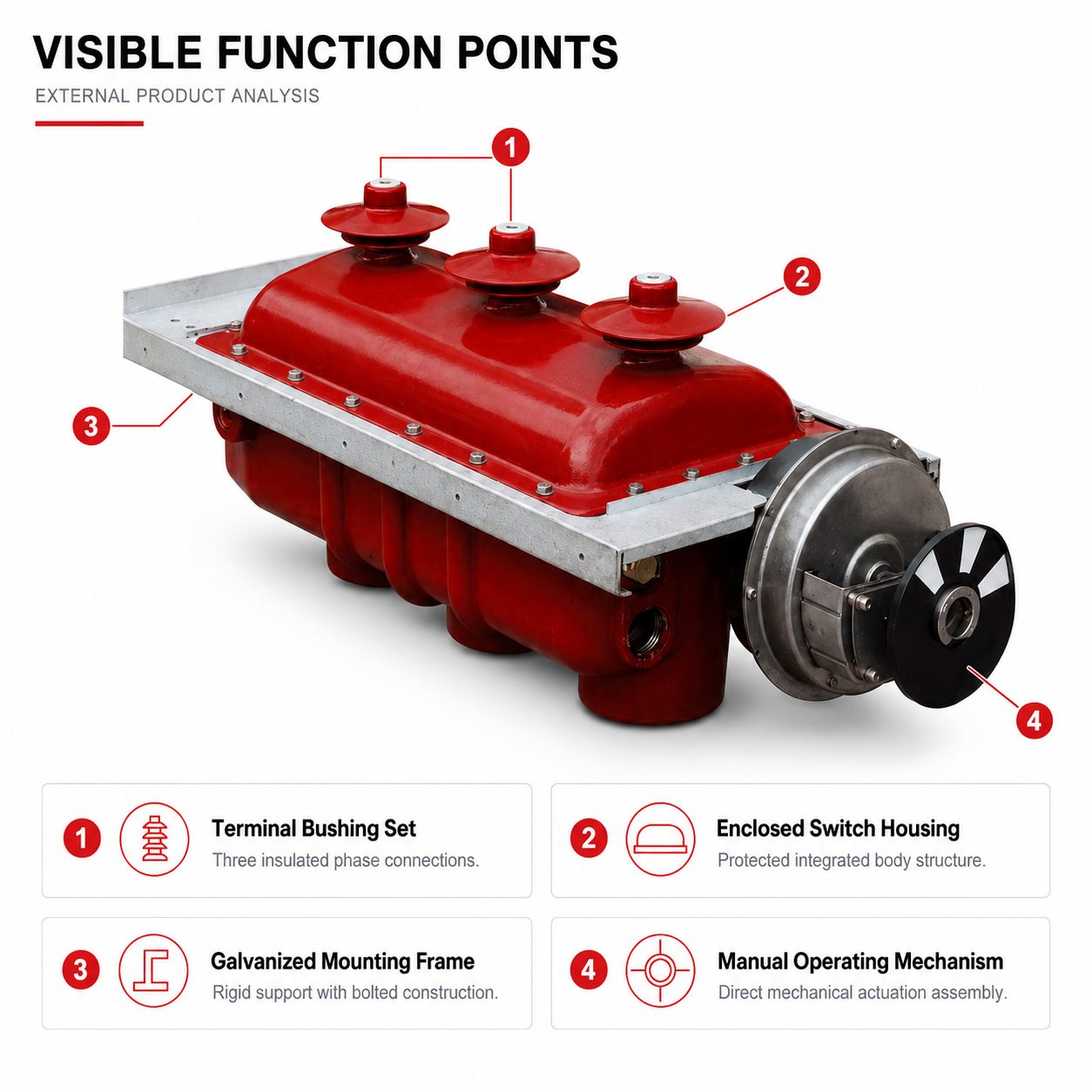
FLN48-12 SF6 indoor load break switch is a three-phase switching device rated at 12kV, designed for ring main unit applications in medium voltage distribution networks. This indoor load break switch features a three-position mechanism (Closed, Open, Earthed) within an enclosed housing with molded terminal bushings for reliable phase isolation. The compact integrated design incorporates three phase terminals into a single enclosed unit with a galvanized mounting frame for rigid support. Rated for normal current switching duties, this SF6 load break switch serves urban cable networks, residential substations, and industrial distribution systems requiring reliable load switching and safe isolation.
- Overview
- Applications
- Technical Data
- Services
- Quality Control
- Recommended Products
FLN48-12 Indoor Load Break Switch - 12kV, 630A Three-Position
FLN48-12 is an indoor load break switch for 12kV secondary distribution, providing Closed, Open and Earthed positions from a single interlocked mechanism. Rated 630A with a 20kA short-time withstand, it is the switching element in ring main cabinets, compact substations and secondary distribution panels on 10kV and 11kV networks.
WHAT A LOAD BREAK SWITCH DOES AND DOES NOT DO
A load break switch makes and breaks load current - it will interrupt a fully loaded 630A feeder safely and repeatedly. It does not interrupt short-circuit current. That distinction defines where it is used: for ring switching, isolation and transformer energising, paired either with an upstream breaker or with series HV fuses where short-circuit protection is required at that point.
Understanding this is what keeps a network safe. A load break switch closed onto an existing fault must survive until the upstream protection clears it, which is why the 50kA peak making capacity and 20kA short-time withstand ratings matter as much as the load breaking rating.
THE THIRD POSITION IS THE SAFETY CASE
The earthed position is not an accessory. A single mechanism drives the switch between Closed, Open and Earthed, mechanically interlocked so that earthing a live circuit is impossible and the cable compartment cannot be opened until the earth is applied. This eliminates the need for a separate earthing device, removes the possibility of applying a portable earth to the wrong circuit, and provides the visible, positively-interlocked earth that safe working procedures require.
RING NETWORK OPERATION
In a ring main cabinet, two FLN48-12 units carry the incoming and outgoing ring cables while a third circuit feeds the local transformer. When a cable section faults, the ring is reconfigured by opening one switch and closing another, restoring supply to every customer except those on the faulted section. This is why urban and industrial estate distribution is built on ring architecture rather than radial feeders.
AIR INSULATION AND F-GAS
FLN48-12 is air-insulated. For EU and Eastern European buyers this removes SF6 inventory reporting, leak-checking obligations and end-of-life gas recovery entirely - a factor appearing more frequently in tender evaluation criteria. The trade-off is environmental sensitivity: air insulation depends on the enclosure staying clean and dry, so for coastal, desert or flood-prone sites a sealed gas-insulated unit is the more durable choice.
MARKET FIT
Serves 11kV Middle East and African networks and 10kV Russian, CIS and Eastern European networks, 50Hz or 60Hz, with GOST 15150 climatic versions available for CIS supply.
PRIMARY APPLICATIONS
- Ring main unit switching cells in HXGN-12 and equivalent compact cabinets - the core application.
- Urban and industrial estate ring feeder switching points on 10kV and 11kV cable networks.
- Compact and packaged substation incoming and outgoing switching.
- Busbar and feeder isolation for maintenance in secondary distribution panels.
- Transformer circuit switching, paired with HV fuses where short-circuit protection is needed.
- Distribution kiosk and pad-mounted substation switching.
- Building services substations in commercial developments, hotels, malls and hospitals.
- Renewable generation collection switching on smaller solar and wind installations.
- Sectionalising points dividing a cable network into independently switchable sections.
WHEN TO SPECIFY A LOAD BREAK SWITCH
Choose a load break switch where the duty is switching and isolation rather than fault interruption: ring reconfiguration, feeder isolation for maintenance, transformer energising and de-energising. It is substantially cheaper and simpler than a breaker and needs no relay, CT or station battery.
Choose a vacuum circuit breaker where the circuit must interrupt short-circuit current directly, requires adjustable coordinated protection, or needs auto-reclosing.
REGIONAL FIT
- Africa: high volume in 11kV secondary distribution, electrification and housing schemes.
- Middle East: 11kV ring networks and compact substations. Suited to indoor, clean, controlled environments; specify sealed SF6 units for coastal and desert siting.
- Russia and CIS: 10kV secondary distribution, GOST R certified with climatic versions for low-temperature sites.
- Eastern Europe: 10kV distribution, with air insulation avoiding F-Gas compliance burden.
NOT SUITABLE FOR
Direct short-circuit interruption without fuses or upstream breaker protection. Frequent switching beyond rated mechanical life. Dusty, humid, coastal or flood-prone environments - specify a sealed SF6 unit. Systems above 12kV - specify FLN36-24.
TECHNICAL DATA - FLN48-12 Indoor Load Break Switch
| Parameter | Value |
| Compliance | IEC 62271-103, IEC 62271-102 (earthing switch function) |
| ELECTRICAL RATINGS | |
| Rated voltage | 12 kV |
| Rated frequency | 50 Hz / 60 Hz |
| Rated power-frequency withstand voltage (1 min) | 42 kV to earth / 48 kV across isolating distance |
| Rated lightning impulse withstand voltage (BIL) | 75 kV peak / 85 kV across isolating distance |
| Rated normal current | 630 A |
| Rated load breaking current | 630 A |
| Rated short-circuit making current | 50 kA peak |
| Rated short-time withstand current | 20 kA for 4 s |
| Rated peak withstand current | 50 kA |
| Rated cable-charging breaking current | 10 A |
| Rated transformer no-load breaking current | 6.3 A |
| SWITCH FUNCTION | |
| Positions | Closed / Open / Earthed - single mechanism, three stable positions |
| Earthing switch making capacity | 50 kA peak |
| Isolating distance | Verified to IEC 62271-102 disconnector requirements |
| Interlocking | Mechanical, preventing earthing of a live circuit and preventing compartment access before earthing |
| Operation | Manual lever standard; motorised AC/DC 110 V or 220 V optional |
| Auxiliary switch | 2NO2NC standard, expandable to 6NO6NC |
| Position indication | Mechanical indicator, direct-driven from the main shaft |
| ENDURANCE | |
| Mechanical life | 2,000 operations minimum (class M1) |
| Load breaking operations at rated current | 100 operations minimum (class E3) |
| Earthing switch making operations | 5 operations at rated making current |
| CONSTRUCTION | |
| Insulation medium | Air |
| Insulating parts | Cycloaliphatic epoxy resin |
| Main contact material | Copper alloy, silver plated |
| Arcing contacts | Arc-resistant alloy tips |
| Arc extinction | Arc chute with rotating arc principle |
| Mounting | Panel-mounted, horizontal busbar orientation |
| Weight | Approximately 45 - 70 kg |
| SERVICE CONDITIONS | |
| Ambient temperature | -25 C to +55 C |
| Altitude | Up to 1000 m standard; up to 2000 m on request |
| Relative humidity | Daily average not exceeding 95%, indoor environment |
OPTIONS
Motorised operating mechanism for SCADA control | HV fuse combination with striker-pin tripping | additional auxiliary contacts | position indication contacts | low-temperature grease for GOST 15150 versions | padlocking facility | voltage presence indicator interface | surge arrester provision
PRE-SALES SELECTION
- Application review against your duty: rated current, breaking capacity, operating sequence, and expected switching frequency.
- Retrofit and replacement sizing. Send us the existing unit's model, pole-centre distance and mounting dimensions and we will confirm interchangeability before you order.
- Grid verification: 12kV class for 10kV (Russia/CIS) and 11kV (Middle East/Africa) networks; 24kV for 20kV and 22kV; 40.5kV for 35kV. Saudi Arabian supply verified at 60Hz.
- Coil, motor and auxiliary-contact configuration specified to your control voltage (AC/DC 110V or 220V) and SCADA interface requirement.
- Low-temperature variants with cold-rated grease and anti-condensation heating for CIS winter service.
MARKET ACCESS AND DOCUMENTATION
- Type-test reports to IEC 62271-100 / IEC 62271-102 / IEC 62271-103 as applicable, issued with the shipment.
- Third-party certification (KEMA, ASTA, CESI, TUV) available where tender documents require witnessed evidence rather than a manufacturer's report.
- Certification support for SASO SABER, SONCAP, KEBS PVoC, ICIGI and GOST R submissions, including HS-code classification (Nigeria has required 10-digit HS codes since March 2025).
TESTING AND DELIVERY
- 100% routine testing before dispatch: power-frequency withstand, contact resistance, mechanical characteristic curve, timing test, and auxiliary circuit verification.
- Individual test report supplied per serial number.
- Export packing with desiccant and moisture barrier; palletised for consolidated shipment.
- Documentation: routine test report, type-test certificate, dimensional drawing, wiring schematic, O&M manual, spare parts list.
AFTER-SALES
- Installation and commissioning guidance, remote support or engineer dispatch.
- Maintenance training covering mechanism inspection, contact wear measurement and vacuum interrupter integrity testing.
- Wear parts (coils, contacts, mechanism components) held in stock for rapid replacement.
- Technical response within 24 hours; multilingual manuals in English, Russian, French and Arabic.
- Warranty: 18 months from delivery or 12 months from commissioning, whichever expires first.
TYPE TESTING
- Type tested to the applicable IEC standard - IEC 62271-100 for circuit breakers, IEC 62271-102 for earthing switches and disconnectors, IEC 62271-103 for load break switches.
- Verified for rated short-circuit breaking and making capacity, short-time withstand current, power-frequency and lightning impulse withstand, temperature rise, and mechanical endurance across the full rated operating sequence.
- Third-party certification from KEMA, ASTA, CESI or TUV available where the tender requires witnessed evidence.
VACUUM INTERRUPTER CONTROL (where applicable)
- Every interrupter is vacuum-integrity tested before assembly; vacuum degradation is the dominant failure mode in a VCB and is not visible externally once installed.
- Contact stroke, over-travel and contact wear allowance measured and recorded per pole.
- Interrupters sourced only from qualified manufacturers with batch traceability.
IN-PROCESS INSPECTION
- Insulating components partial-discharge tested before assembly.
- Mechanism spring force and charging characteristic verified against specification.
- Pole-centre distance and mounting interface dimensions checked against drawing - critical for retrofit interchangeability.
- Plating thickness on current-carrying contacts verified per batch.
ROUTINE TESTING - 100%, NO SAMPLING
- Power-frequency withstand voltage across the open contacts and to earth.
- Main circuit contact resistance measurement.
- Mechanical characteristic curve: closing time, opening time, contact bounce, and three-phase simultaneity.
- Operating mechanism function at minimum, rated and maximum control voltage - a unit that only operates at nominal voltage will fail during a real disturbance when station battery voltage sags.
- Auxiliary switch continuity and position signalling verification.
- Serialised routine test report issued with every unit.
TRACEABILITY AND SYSTEM
- ISO 9001 quality management system.
- Serial number traceability to vacuum interrupter batch, mechanism batch and insulation component batch.
- Test records retained for the warranty period and available on request.
ENVIRONMENTAL QUALIFICATION
Where the destination environment exceeds IEC reference conditions we qualify against it: elevated-ambient temperature-rise verification for Gulf service, salt-spray testing for coastal sites, and low-temperature operation verification with cold-rated lubricant for GOST 15150 climatic versions.