EN

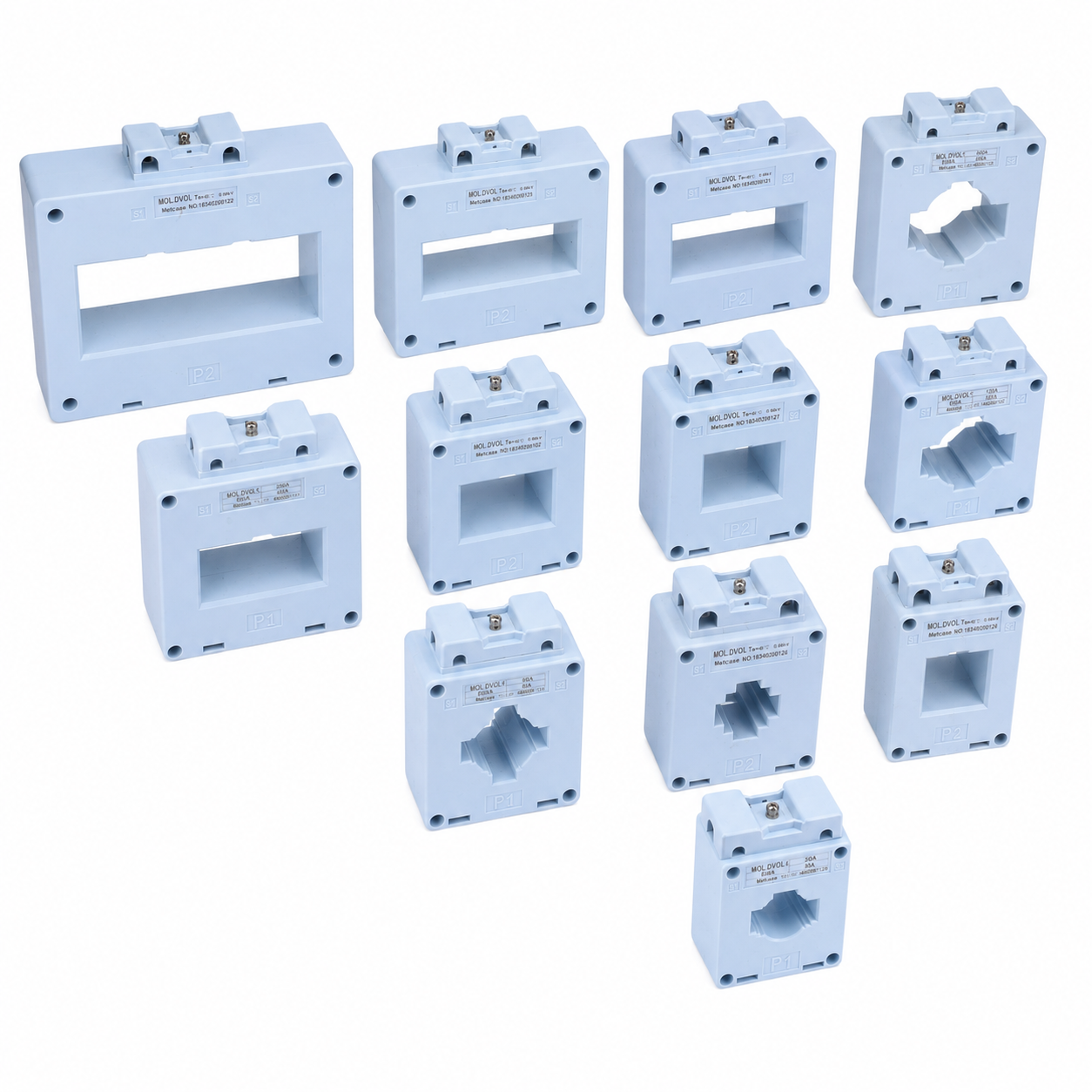
What Is a Current Transformer?
A current transformer is an instrument transformer that produces a proportional secondary current — typically 1 A or 5 A — from a high primary current flowing in the primary circuit. The secondary output feeds metering instruments and protection relays without exposing them to the full primary circuit voltage, making the current transformer a fundamental safety and measurement component in low-voltage distribution systems.
The BH-0.66 current transformer in this category is rated at 0.66 kV with a primary current range from 5 A to 5000 A. Available in bar-type and window-type designs, it complies with IEC 61869-2, the principal international standard governing current transformer performance requirements. The bar-type design uses the primary busbar conductor directly; the window-type design requires the primary conductor to pass through the aperture.
Key Product Specifications
- Rated voltage: 0.66 kV — suited to standard low-voltage distribution panels and switchboards where a current transformer rated below 1 kV is required
- Primary current range: 5 A to 5000 A, covering feeder metering through large busbar applications
- Secondary current: Standard 5 A output compatible with conventional metering instruments and protection relay circuits
- Metering accuracy classes: 0.2S and 0.5S for revenue metering; 0.5 and 1.0 for general energy measurement applications
- Protection accuracy classes: 5P10 and 10P10 for protection relay applications requiring accurate fault current representation
- Mounting types: Bar type and window type, suited to different busbar configurations and panel form factors
- Compliance standard: IEC 61869-2, equivalent to GB 20840.2 under the Chinese national standard
Understanding the accuracy class difference matters for correct current transformer specification. The 0.2S and 0.5S classes maintain accuracy at low current fractions — important where load profiles vary significantly across the day. The 5P10 and 10P10 classes define the composite error at the accuracy limit factor, which governs behavior during fault conditions. Selecting a metering-class device for a protection relay application — or vice versa — is a specification mismatch that often surfaces only at commissioning or after a relay misoperation event.
Typical Applications
Low-voltage current transformers rated at 0.66 kV are installed across a broad range of distribution environments:
- LV distribution panels and switchboards — measuring load current on outgoing feeders for energy monitoring, load balancing, and billing
- Industrial plant main incoming feeders — measuring current at the LV side of a power transformer for protection coordination
- Commercial building main distribution boards — demand monitoring for automated energy management systems
- Utility billing metering points — where accuracy class 0.2S or 0.5S is specified for revenue-grade measurement
- Renewable energy collector systems — monitoring feeder currents at PV inverter outputs or wind turbine step-up connections
- Motor control centers — current sensing for overload protection relays requiring standard 5 A secondary output
If the system operates at 0.4 kV or 0.66 kV nominal voltage and the primary current falls within the 5 A to 5000 A range, a current transformer from this category is directly applicable. If measurement above 1 kV is required, a medium-voltage current transformer rated to the relevant voltage class and applicable IEC standard edition is needed instead.
How to Select the Right Current Transformer
Selecting a current transformer for a specific application follows a structured sequence. Each decision gate depends on the previous one — skipping any step tends to create problems at commissioning or, less favorably, after a protection relay misoperation.
- Determine the maximum primary current. This sets the rated primary current (In1) of the current transformer. Choose a standard ratio with In1 at or above the maximum continuous load current. Significant over-sizing degrades metering accuracy: a current transformer with a 3000/5 A ratio on a feeder carrying 200 A will operate at a very low current fraction, reducing accuracy even in 0.5-class devices.
- Confirm the secondary current standard. The 5 A secondary is conventional for industrial and utility metering panels. Some digital relays accept both 1 A and 5 A inputs — verify the relay's secondary current input rating before finalizing the current transformer order.
- Select the accuracy class for the application. For revenue metering: class 0.2S or 0.5S. For protection relay applications: class 5P10 or 10P10. For general panel metering without billing implications: class 0.5 or 1.0. The accuracy class directly determines whether the current transformer's measurement is adequate for its purpose.
- Calculate the burden (VA). The current transformer's rated burden must exceed the total connected secondary load — the sum of all instrument inputs, relay coil consumption, and secondary wiring resistance. If the connected burden exceeds the rated value, the device will saturate under normal operating conditions, causing measurement errors.
- Confirm the insulation voltage. For 0.66 kV systems, the BH-0.66 provides the appropriate rated insulation voltage. Verify that the insulation level matches the system's maximum operating voltage with adequate margin.
- Select the current transformer mounting type. Bar-type and window-type designs each suit different busbar geometries. Confirm panel clearances before ordering — dimensional incompatibility at installation is an avoidable source of delay in panel assembly projects.
- Verify the applicable standard for the current transformer. IEC 61869-2 is the current edition for low-voltage current transformers in most international project specifications. If the project references IEC 60044-1 — the superseded edition — confirm with the specifier whether IEC 61869-2 compliance is accepted as equivalent. Projects in Russia, Brazil, Indonesia, or Turkey may reference GOST, ABNT, or SNI harmonized equivalents largely aligned with IEC 61869-2.
Standards Compliance and Type Test Documentation
Passing IEC 61869-2 type testing is a necessary starting point — not a guarantee of equivalent performance in every field installation. The gap is relevant when site conditions differ from the test protocol assumptions. Under IEC 61869-2, current transformer ratings are specified at a standard reference ambient temperature. In climates where ambient temperatures regularly exceed 45 to 50°C — common in Southeast Asia, the Middle East, and equatorial Africa — thermal derating applies to the effective continuous current rating. A current transformer installed in a panel with high internal temperatures during peak load may exhibit measurement error beyond the nameplate accuracy class if derating has not been factored into the specification.
IEC compliance is the international baseline, not a guarantee that a current transformer will clear all local utility or national grid operator requirements without further review. In markets like Russia (GOST), Brazil (ABNT), or Indonesia (SNI), additional documentation requirements apply on top of the IEC base. Technical reviewers for metering approvals, protection relay commissioning documents, and utility grid connection packages increasingly require type test reports from an accredited laboratory — not a self-declaration of compliance. A type test report documents the specific accuracy class, burden, and accuracy limit factor that were actually tested, providing the verifiable traceability that reviewers need to evaluate against the specification.
Requesting the type test certificate before placing the purchase order — and verifying that it covers the specific accuracy class and burden you are specifying — is a straightforward practice that protects the project from disputes arising after delivery.
Procurement Notes for International Buyers
For buyers sourcing current transformer products through international trade channels, a few evaluation criteria have particular relevance beyond the product specification itself:
- Type test report scope: Confirm that the IEC 61869-2 type test report covers the specific accuracy class and burden you require. Type test results are class- and burden-specific; a report for a different accuracy class in the same product family does not validate the specification you are ordering.
- Product range coverage: A supplier offering the full primary current range from 5 A to 5000 A within a single current transformer series simplifies procurement when a project requires multiple ratios across different panel designs. Sourcing all ratios from a single product family reduces the number of qualification submissions required.
- Export market documentation capability: Projects in markets such as Russia, Brazil, Chile, Indonesia, Thailand, and Poland may require documentation beyond standard IEC test reports. Confirm the supplier's experience managing compliance documentation for your target market — delays at the import clearance or project submittal stage are common when documentation requirements are not addressed early.
- Batch dimensional consistency: For panel builders assembling standard designs across multiple production runs, dimensional consistency between delivery batches affects production line efficiency. Confirm whether the supplier applies routine dimensional checks as part of outgoing inspection for each current transformer batch.
- Accuracy class and relay compatibility: A protection relay misoperation due to incorrect current transformer accuracy class specification is a high-impact event that typically surfaces only after installation. Verify that the current transformer accuracy class — metering or protection — matches both the relay burden and the intended measurement function before the purchase order is placed.