EN

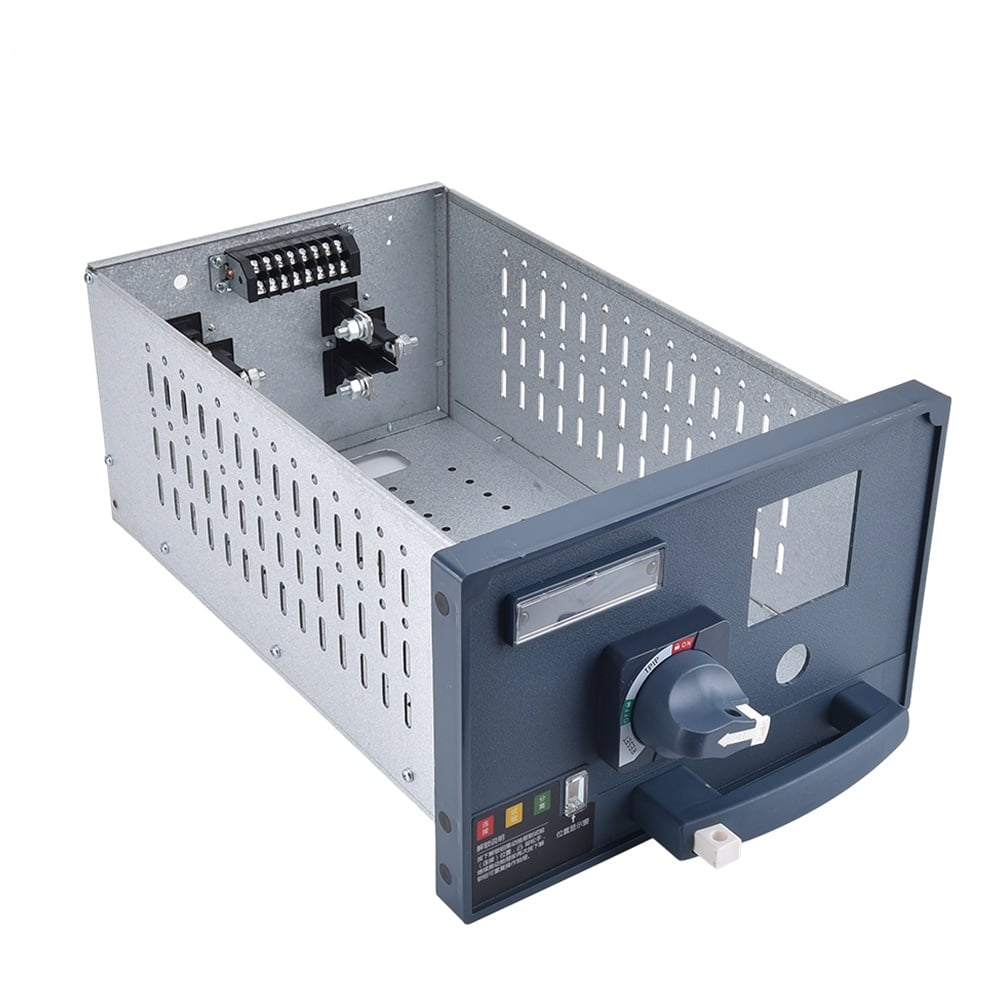
What Are L.V Switchgear Drawer Modules?
An L.V Switchgear Drawer is the self-contained functional unit at the core of drawer-type low-voltage distribution and motor control panels. Each unit — whether a withdrawable format for GCK, GCS, or MNS panels or a Blokset plug-in module — houses the circuit protection, motor control, or feeder distribution components for a single circuit on a standardized frame. The frame allows independent movement between connected, test, and disconnected positions, so maintenance teams can isolate, inspect, or replace one unit without de-energizing the entire panel or interrupting parallel circuits.
This L.V Switchgear Drawer category spans current ratings from 63A for half-unit high-density configurations to 630A for full-width 6M Blokset modules, covering the most widely deployed panel platforms in industrial and commercial markets. The units in this range are designed for three-phase AC systems at up to 690V, which covers the majority of installations connected to public distribution grids globally.
Key Product Characteristics
The functional and structural features common across this L.V Switchgear Drawer range include the following:
- Three-position mechanical isolation: Every withdrawable unit includes defined mechanical positions for connected, test, and disconnected states. This allows protection circuits to be tested with the power path isolated, and individual drawers to be safely withdrawn without affecting adjacent circuits in the panel.
- Silver-plated contact interfaces: Withdrawable units use silver-plated connection contacts to maintain stable contact resistance through repeated insertion and withdrawal cycles. In practice, contact condition after several years of service depends on whether each L.V Switchgear Drawer has been operated through its full position range regularly — contacts that remain static for extended periods behave differently at re-energization than those exercised during routine maintenance cycles.
- Weld-free 8MF frame for Blokset modules: Blokset format modules use a weld-free 8MF modular frame system with a peak fault withstand of 73.5kA, reducing on-site assembly complexity and supporting structural rigidity in high fault-level environments.
- Factory-wired and tested: All units are factory-wired and tested before shipment. CKD (complete knock-down) kit options are available for markets where local assembly is required by project conditions.
- Range of heights and widths: Withdrawable formats include half-unit, 1-unit, 1.5-unit, and 2-unit heights for GCK, GCS, and MNS systems. Blokset modules are available in 3M full-width, 4M/2 half-width, and 6M full-width configurations, enabling mixed-current setups within a single panel enclosure.
- Extended depth for VFDs and soft starters: The 1.5-unit and 2-unit formats provide additional internal depth and ventilation for variable frequency drives and large motor starters that exceed the volume of standard 1-unit configurations.
Common Applications
The L.V Switchgear Drawer is specified wherever controlled maintenance access to individual circuits is built into the panel design. Typical deployment contexts include:
- Industrial manufacturing plants: Motor feeders and production line protection circuits are housed in motor control center panels using withdrawable formats. The ability to exchange a single L.V Switchgear Drawer during a planned maintenance window — without taking the full panel offline — is the primary operational reason for specifying drawer-type panels over fixed-mounting alternatives in continuous production facilities.
- Power plants and substations: Auxiliary LV switchboards use withdrawable drawer units for feeder and motor control circuits that support plant auxiliary systems. Three-chamber construction — separating bus chamber, drawer chamber, and cable chamber — isolates conductor categories within the panel for operational safety.
- Commercial and institutional buildings: Hotels, hospitals, and large office complexes use drawer-type distribution boards where circuit isolation without full panel shutdown is operationally practical during scheduled maintenance periods.
- Infrastructure and municipal facilities: Water supply, wastewater treatment, and transportation infrastructure use L.V Switchgear Drawer configurations for motor control and feeder circuits where access during live operation is part of the maintenance schedule.
- Mining and heavy industry: Continuous-operation environments place high value on the ability to service individual circuits without production downtime, making drawer-type formats the standard specification for demanding applications in this sector.
How to Select the Right L.V Switchgear Drawer
Selecting the correct format requires more than matching the ampere rating. From a distributor perspective, the selection priorities shift depending on the installed panel platform and the end market being served.
Step 1 — Confirm panel platform compatibility. GCK, GCS, MNS, and Blokset are mechanically distinct systems with different frame dimensions, busbar interfaces, and connection arrangements. An L.V Switchgear Drawer format specified for one platform will not fit another without modification. Confirming the panel platform before ordering is the most basic — and most frequently overlooked — step in the procurement process. Interface mismatches between a newly sourced unit and an existing panel layout are a known cause of production delays when panel builders switch supplier mid-project.
Step 2 — Apply ambient temperature derating to the rated current. You might expect that selecting an L.V Switchgear Drawer rated above the calculated full-load current is the complete specification step. The complication is that current ratings on LV switchgear are defined at a standard ambient temperature — typically 40°C under IEC parameters. In markets where ambient temperatures in switchgear rooms regularly reach 45–50°C, the effective safe continuous loading is lower than the nameplate value indicates. This applies to installations across tropical markets in Southeast Asia, sub-Saharan Africa, and parts of South America and the Middle East.
Step 3 — Evaluate the maintenance access requirement. The case for a withdrawable L.V Switchgear Drawer over a fixed functional unit is strongest when the installation is designed around planned maintenance access during live operation. If the system topology includes redundant feeders or drawer access frequency is low, the draw-out mechanism and the additional cabinet depth it requires represent a cost premium that needs to be justified by the actual maintenance schedule.
Step 4 — Specify dimensional consistency for repeat orders. For panel builders sourcing drawers against a validated panel design, dimensional consistency between delivery batches is a practical qualification criterion alongside unit price. Batch-to-batch variation in terminal positions or busbar interface dimensions disrupts standardized production processes and may require panel redesign.
Sourcing Considerations for the L.V Switchgear Drawer
For distributors and panel builders, sourcing L.V Switchgear Drawer units from a range that covers multiple current ratings and drawer heights within a single supplier relationship has practical advantages beyond unit pricing. These modules are not commodity items with full cross-brand interchangeability — a format change that affects terminal positions or busbar interface dimensions requires panel layout redesign, documentation revision, and re-validation of the standard panel configuration. Panel builders who have validated a specific format tend to maintain supplier consistency as long as supply remains reliable and price-competitive.
A product range covering half-unit 63A formats through to full-width 630A Blokset modules within a single supply relationship reduces the number of supplier qualifications needed across a full panel bill of materials. This consolidation is relevant for panel builders managing standardized production BOMs and for distributors managing inventory across customer accounts with mixed current rating requirements.
The general guidance from recognized electrical standards bodies in IEC-aligned markets is that each L.V Switchgear Drawer should be selected based on verified mechanical and electrical compatibility with the installed panel platform — not on ampere rating or price alone. Adding a compatibility verification step when introducing a new supplier is consistent with established industry practice and reduces the risk of installation-phase problems that are costly to address after panel assembly is complete.