
 EN
Understanding High-Temperature Challenges in Switchgear Cabinets
Typical Operating Temperatures and Thermal Stress Sources (Busbars, Load Cycling, Enclosure Design)
Switchgear cabinets experience elevated temperatures primarily due to resistive losses in busbars and contact points—areas of highest current density. Under rated load, internal air temperatures typically stabilize 40–60°C above ambient, while localized hot spots at connections can reach 120–150°C. Load cycling—repeated current fluctuations—induces thermal expansion and contraction in conductors and connectors, gradually loosening bolted interfaces. This increases contact resistance, triggering a self-reinforcing heating cycle. Enclosure design further compounds thermal stress: sealed cabinets without forced ventilation trap heat, and outdoor units absorb solar radiation, pushing internal temperatures even higher.
These conditions degrade both insulating materials and mechanical components. Cable clamps, for example, must maintain clamping pressure and electrical isolation despite prolonged heat exposure and repeated thermal cycling. Without appropriate material selection, clamps may embrittle, lose tension, or allow cable migration—potentially leading to arc flash hazards. Recognizing these interrelated thermal challenges is essential when specifying cable management solutions for demanding switchgear environments.
High-Performance Cable Clamp Materials for Elevated Temperatures
Selecting the right cable clamp material for high-temperature switchgear requires balancing thermal stability, mechanical strength, and environmental resistance. Two primary material classes—stainless steel and advanced polymers—offer complementary advantages.
Stainless Steel Cable Clamps: Sustained Strength and Corrosion Resistance Above 150°C
Stainless steel cable clamps retain structural integrity and clamping force far beyond the limits of most polymers. Grades such as 304 and 316 maintain tensile strength and creep resistance at continuous operating temperatures above 150°C, with brief excursions up to 260°C possible without permanent deformation. Unlike carbon steel, stainless alloys form a durable chromium oxide layer that provides enduring corrosion resistance—even under elevated temperatures—against humidity, mild acids, and salt spray common in industrial power applications.
Thermal expansion coefficients of stainless steel (16–18 µm/m·°C) closely match those of typical switchgear enclosure metals, minimizing thermomechanical stress on cables during temperature cycling. Load-retention testing shows 316 stainless steel clamps lose less than 5% of their original clamping force after 1,000 thermal cycles from room temperature to 200°C. This ensures consistent cable bundling and routing, even adjacent to busbars or during high-current load cycling. For applications requiring non-magnetic properties or superior acid resistance—such as near battery rooms or in offshore installations—316L (low-carbon) variants are often specified.
Heat-Resistant Polymer Cable Clamps: UL94 V-0 Thermosets, Polyimide Composites, and Their Real-World Limits
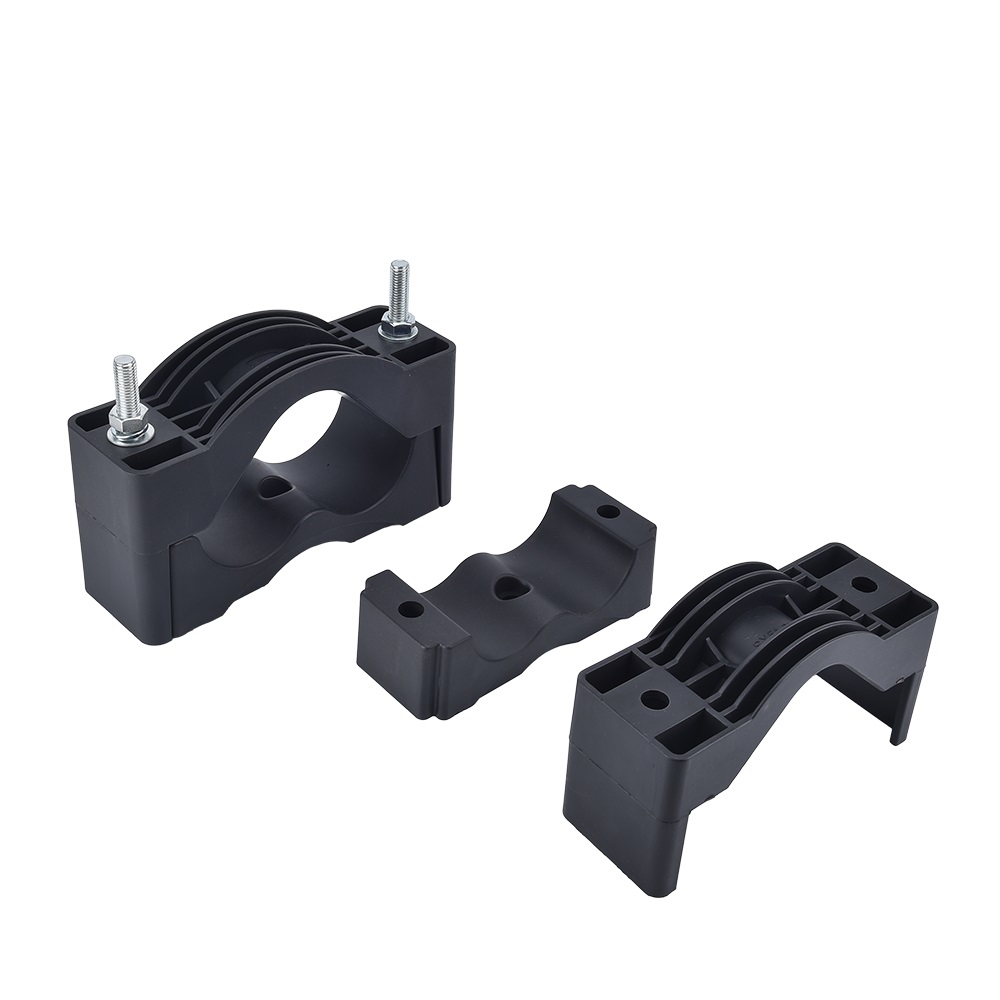
Polymer-based cable clamps deliver electrical insulation, design flexibility, and flame-retardancy—critical for fire safety in switchgear. Their thermal performance varies significantly by base resin. Heat-stabilized nylon 6/6 (PA66) clamps serve reliably up to 125°C continuous and meet UL94 V-2 or V-0 ratings (with additives). Polyamide 46 (PA46) extends the usable range to 150–170°C while retaining inherent self-extinguishing behavior. For the most demanding applications, polyetheretherketone (PEEK) clamps maintain structural integrity at 240°C continuous and resist hydrolysis, fuels, and aggressive coolants. Polyimide composites exceed 300°C but are generally reserved for niche aerospace or nuclear applications due to cost.
The table below summarizes key thermal and flame-retardant properties of common high-temperature polymer cable clamp materials:
| Material | Max Continuous Operating Temp (°C) | UL94 Rating | Typical Use Cases |
|---|---|---|---|
| Heat-Stabilized Nylon 6/6 (PA66) | 125 | V-2 (V-0 with additives) | General electrical bundling, moderate-heat compartments |
| Polyamide 46 (PA46) | 150–170 | V-0 | Engine compartments, adjacent to heating elements |
| PEEK | 240 | V-0 | High-heat switchgear, chemical processing, aerospace |
| Polyimide Composites | >300 | V-0 | Nuclear, radiation-prone environments, ultra-high-temp terminals |
Real-world performance depends on long-term thermal aging—not just peak ratings. Even heat-stabilized PA66 clamps can lose up to 30% of initial tensile strength after 1,000 hours at 150°C due to oxidative embrittlement. PEEK, though robust, may undergo creep if continuously loaded near its glass-transition temperature (~143°C). Designers must therefore evaluate expected exposure duration, thermal cycling frequency, and dielectric requirements—ensuring the selected polymer remains within its safe-stress zone over the equipment’s full service life.
Critical Non-Thermal Factors in Cable Clamp Selection
Mechanical Load Retention, Electrical Isolation Integrity, and Resistance to Oils, Ozone, and UV in Industrial Environments
In high-temperature switchgear, cable clamp performance hinges on more than thermal endurance. Mechanical load retention is critical to withstand continuous tension from cable weight, cyclic thermal expansion, and vibration—forces that can loosen fixings over time and lead to conductor movement or phase-to-phase faults. Equally vital is electrical isolation integrity: insulating components must sustain dielectric strength throughout service life, preventing creepage currents or flashover under voltage stress and humidity.
Industrial environments also expose clamps to oils, ozone, and ultraviolet radiation—agents known to accelerate polymer embrittlement and stress cracking. These factors degrade clamping force and insulation reliability independently of temperature. A clamp that demonstrably resists this combined non-thermal stress profile ensures long-term safety and functional reliability—making it essential to assess all three dimensions together when selecting for real-world switchgear applications.
Practical Guidance for Specifying Cable Clamps in High-Temp Switchgear Applications
Begin by defining the maximum continuous and peak operating temperature of your switchgear cabinet. For environments consistently above 150°C, stainless steel clamps provide unmatched strength and dimensional stability. For moderate heat exposure up to 180°C—and where low mechanical loading and electrical isolation are priorities—heat-resistant polymer clamps made from polyimide composites or UL94 V-0 flame-retardant thermosets can be effective.
Always evaluate mechanical load retention, electrical isolation integrity, and resistance to oils, ozone, and UV—factors that often determine field reliability as much as temperature rating. Cross-check supplier data sheets against relevant industry standards—including IEC 61984 for connector safety and UL 508A for industrial control panels—and request accelerated aging test reports when available. Finally, consider installation and maintenance access: a well-specified clamp is only as reliable as its correct application. A systematic evaluation across these criteria ensures safe, organized, and durable cable management throughout the switchgear’s operational life.
FAQ
What are the common sources of thermal stress in switchgear cabinets?
Thermal stress in switchgear cabinets arises from resistive losses in busbars, load cycling-induced expansion/contraction of conductors, and poorly ventilated enclosures that trap heat. Outdoor units can also absorb solar radiation, exacerbating internal temperature rise.
What materials are ideal for cable clamps in high-temperature environments?
Stainless steel (e.g., grades 304, 316, 316L) offers superior strength and corrosion resistance at temperatures above 150°C, while polymers like PEEK and polyimide are suited for moderate heat applications, providing electrical insulation and design flexibility.
How do you evaluate polymer cable clamp performance for switchgear?
Evaluate polymer clamp performance based on continuous operating temperature, flame-retardancy ratings (UL94 classifications), and resistance to environmental conditions like UV, oils, and ozone.
Are non-thermal factors critical in cable clamp selection?
Yes, non-thermal factors such as mechanical load retention, electrical isolation integrity, and environmental resistance (to oils, UV, ozone) are equally essential for ensuring long-term functional reliability in switchgear systems.
How should cable clamps be specified for thermal cycling scenarios?
For thermal cycling, stainless clamps with matching expansion coefficients to enclosure metals minimize stress, whereas polymers should demonstrate robust thermal aging performance and reduced oxidative embrittlement.
Table of Contents
- Understanding High-Temperature Challenges in Switchgear Cabinets
- High-Performance Cable Clamp Materials for Elevated Temperatures
- Critical Non-Thermal Factors in Cable Clamp Selection
- Practical Guidance for Specifying Cable Clamps in High-Temp Switchgear Applications
-
FAQ
- What are the common sources of thermal stress in switchgear cabinets?
- What materials are ideal for cable clamps in high-temperature environments?
- How do you evaluate polymer cable clamp performance for switchgear?
- Are non-thermal factors critical in cable clamp selection?
- How should cable clamps be specified for thermal cycling scenarios?